
Google’s New “Add to Preferred Sources” Button: What It Means for Your Website
Written by Christopher Carbaugh, founder of Hoot Host
Google just rolled out a new feature that puts more control in the hands of searchers – and, if you play it right, more loyal traffic in the hands of website owners.
It’s called Google Preferred Sources button, and you can see it added to our own website footer below!
We wanted to walk through what this feature actually does, what it doesn’t do, and why we think it’s a meaningful addition to any well-rounded search optimization strategy – not because it will boost your rankings, but because of what it can do for the relationship you’re building with the people who already like what you publish.
What Is Google Preferred Sources?
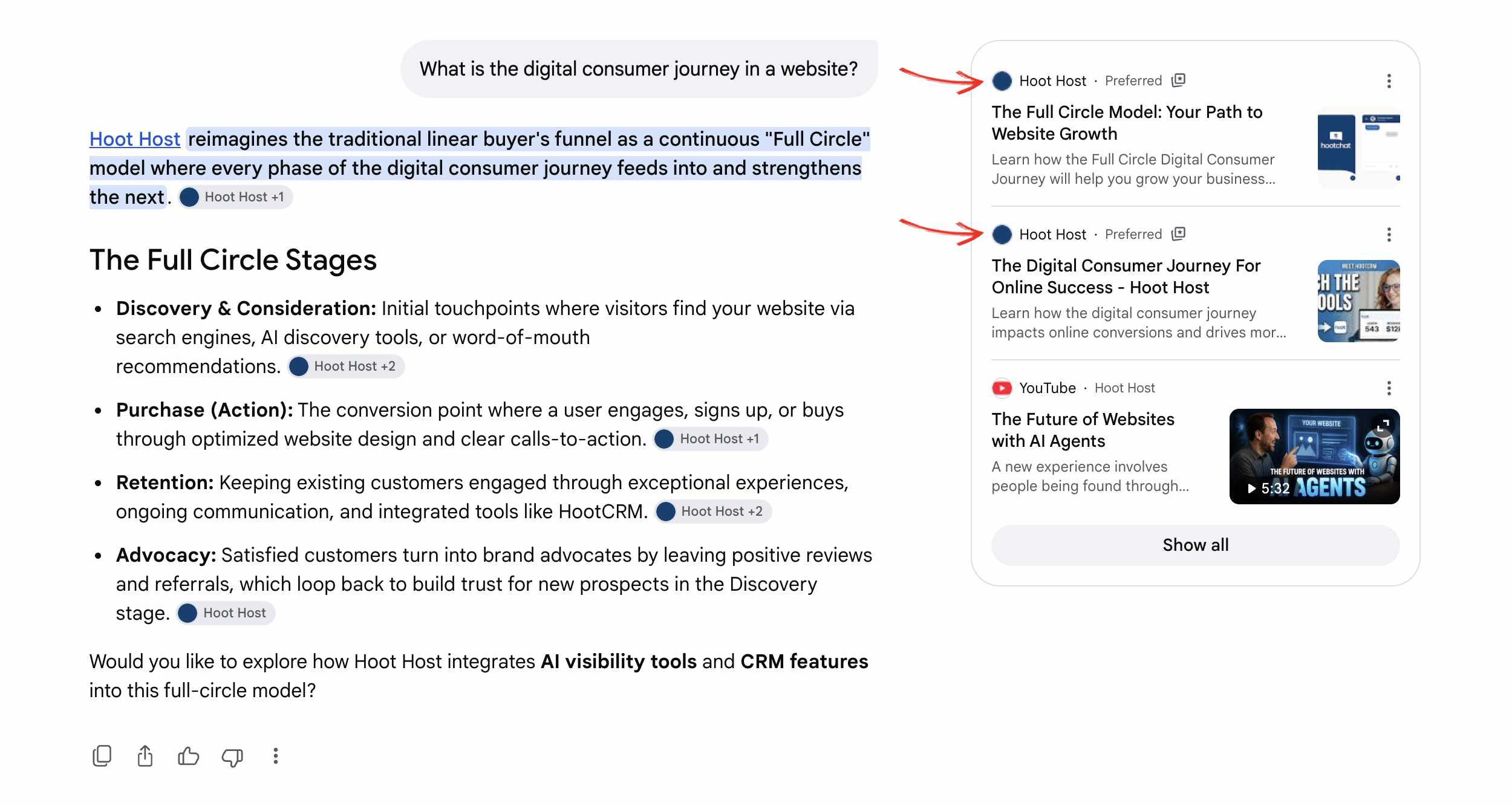
Preferred Sources is a new, user-facing feature from Google that lets people mark specific websites as sources they trust and want to see more of. When a visitor clicks the “Add to Preferred Sources” button on your site, Google adds your domain to that person’s personal list of preferred sources. From then on, your content is more likely to surface – carrying a visible “preferred” badge – when that person searches for topics you cover, including in Google’s Top Stories carousel, AI Overviews, and AI Mode.
Google has reported that people have already selected more than 600,000 unique sources since introducing the feature, which gives a sense of how quickly readers are engaging with it.
Practically speaking, it works like this:
1. A site owner adds Google’s button (a short snippet of code) to their website – Hoot Host has placed ours in the footer of this page so you can see how it looks.
2. A visitor who enjoys the content clicks the button and confirms the site as a preferred source, right from a Google-hosted preference panel.
3. Going forward, when that visitor searches Google and your content is relevant, your site is more likely to appear with a “preferred” badge, and to be pulled into Top Stories, AI Overviews, and AI Mode responses.
It’s important to note that only domain – and subdomain-level sites are eligible – a specific blog subdirectory can’t be marked as preferred on its own, the preference applies to the site as a whole.
What This Feature Is Not
Before we get into the benefits, it’s worth being direct about what Preferred Sources is not, because there’s already some confusion circulating about this tool.
It is not a universal ranking factor.
Google’s own documentation is clear that Preferred Sources does not boost your site’s broad domain authority, and it does not change how Google ranks your pages for new visitors who have never heard of you – what we’d call “cold” traffic. If you’re hoping this button will move the needle on your general search rankings, it won’t. That’s simply not what it’s built to do. So anyone claiming otherwise is misinformed or selling you a falsehood.
So if it’s not an SEO ranking lever, why are we recommending it? Because it’s built to do something arguably just as valuable for a growing business: help you keep the audience you’ve already earned!
Key Search Optimization and Visibility Benefits
Here’s where Preferred Sources actually moves the needle, based on what Google has shared and how the feature is designed to function:
1. Audience retention: Preferred Sources acts as a retention lever. For the visitors who already like your content enough to opt in, it makes sure your fresh articles, updates, and offers are easy to find the next time they search – rather than leaving it to chance.
2. Higher click-through rates: According to data shared by Google, users are roughly twice as likely to click on a search result labeled with a preferred source badge compared to an unlabeled one. That badge is a visible trust cue at the exact moment someone is deciding where to click, and it appears to meaningfully change behavior.
3. Placement in AI-driven search: Sites that visitors have saved as a preferred source gain prime placement in relevant topic searches, Top Stories, AI Overviews, and other AI-driven search experiences. As more search behavior shifts toward AI-generated summaries and conversational results, having a direct line into those experiences with your most engaged readers is a meaningful advantage.
Taken together, the theme is consistent: this tool isn’t about winning new visitors through better rankings. It’s about making sure the people who already chose you keep finding you.
Trust Signals, Repeat Visitors, and the Relationship With Your Audience
This is really the heart of why Preferred Sources matters. Search engines, and Google in particular, have been leaning harder into signals of trust, expertise, and genuine reader relationships – think E-E-A-T (Experience, Expertise, Authoritativeness, and Trustworthiness) — and Preferred Sources is a direct, visible extension of that shift. It turns an abstract idea like “trust” into something a visitor can act on with a single click.
For a business, that click is meaningful in a few ways:
• A visitor who adds your site as a preferred source is telling Google, in plain terms, that your content is worth coming back to. That’s a stronger trust signal than a passive visit or a single page view, because it requires deliberate action from the reader.
• It also gives your business a repeat channel that doesn’t rely purely on paid ads, email lists, or social algorithms. Once someone marks you as preferred, Google itself becomes part of the mechanism that brings them back to you, badge and all, the next time they’re searching a relevant topic.
• And it reinforces a habit loop that benefits every other part of your digital consumer journey. A visitor who returns because of a preferred source badge is more likely to browse further, engage with your calls to action, sign up for your newsletter, or eventually convert into an actual customer — because they’ve already demonstrated that they trust your brand.
In short, this feature rewards businesses that are already publishing genuinely useful, consistent content. It’s less a growth hack and more a loyalty mechanism: a way to formalize the relationship between a business and the audience that already values it.
What This Means for Hoot Host Clients
At Hoot Host, every website we build or manage includes our Google SEO Essentials as a standard benefit. As we watch this feature mature and gather more real-world data on its impact, we plan to bring the “Add to Preferred Sources” button into that package and roll it out to client websites where it makes sense.
We’ll be watching a few things closely as this rolls out more broadly across the web: how consistently the preferred badge affects click-through rates across different industries, how much AI Overview and AI Mode placement actually shifts as more users opt in, and how best to encourage visitors to take that extra click without being pushy about it.
For now, our take is simple: this isn’t a tool that will make a new visitor rank you higher. It’s a tool that makes it easier for the visitors who already like you to keep choosing you — and in an increasingly AI-driven search experience, that kind of durable, opted-in relationship with your audience is worth building.
We’ll Add The Button For You!
Looking to have the preferred sources button added to your website? We’ll add it to your website completely for free – all you have to do is click our Add to Preferred Sources button in the footer at the bottom of this page. Then simply contact us and we’ll be happy to help you set it up on your website.
Sources:
1. Google — Personalize your search and discover more news from your favorite sites: https://blog.google/products-and-platforms/products/search/personalize-search-discover-news
2. Google Search Central — Preferred Sources documentation: https://developers.google.com/search/docs/appearance/preferred-sources