
Voice search isn’t coming. It’s already here – and most small business websites aren’t ready for it.
That’s not a scare tactic. It’s just where things are. Smart speakers are now in roughly 1 in 3 U.S. households, and mobile voice search continues to grow fast. People are asking out loud “Hey Google, find a coffee shop near me” or “Alexa, who does HVAC repair near me” – and Google or AI search assistants are deciding who to cite. Not who has the best-looking website. Not who ranked #1 in traditional search results 5 years ago. Who answers the question best today.
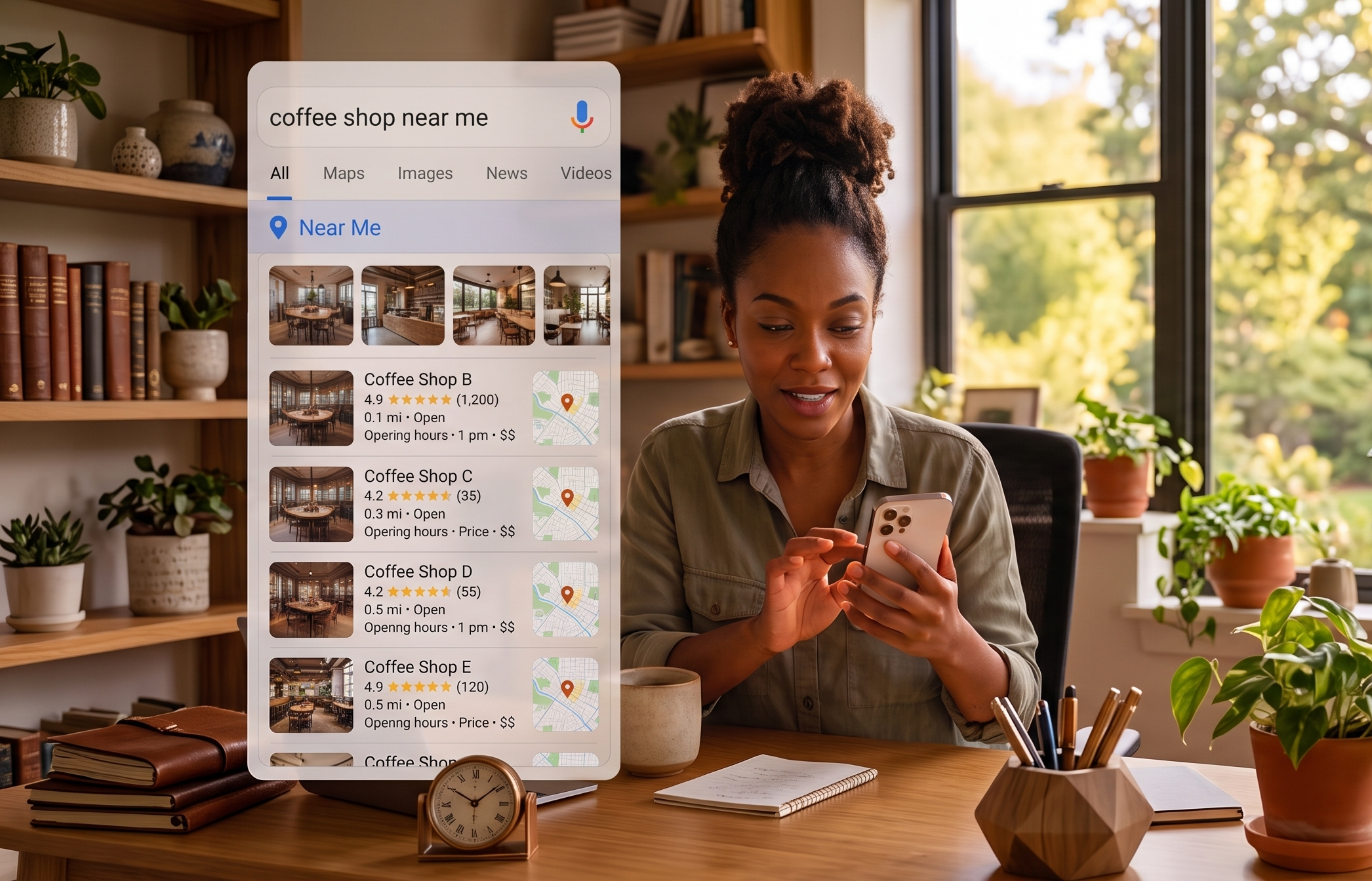
That’s a very different game than the one most small business owners have been playing.
How Voice Search Actually Works
When someone types a search query, they get a list of results. For now anyway, Google is increasingly pushing full AI Mode on their users. The old ten blue links, some ads, a map pack, or just AI conversational discovery mode. They browse, compare, talk it out with Google AI, maybe click around some. In this online experience, your website has some chance to win them over visually.
Voice search doesn’t work that way. When someone asks a question out loud, Google or an AI assistant picks one answer to read back to them. One business. One result. The person asking may never look at a screen at all.
This means the signals Google uses to decide who to cite for a voice query are different from traditional SEO signals. It’s less about keyword density and backlinks, and more about clarity, trust, and completeness.
Why Most Small Business Websites Aren’t Built for This
Most small business websites were designed with a visual browser in mind – someone who lands on the homepage and scrolls through the content. The copy is formal. The sentences are long. Information is organized the way a brochure is organized, not the way a conversation flows.
That works fine when someone is sitting at a desk with time to browse. It doesn’t work when someone is driving, cooking, or walking and asks their phone a quick question. In that moment, Google isn’t sending them to browse your homepage. It’s pulling a direct answer – and if your site isn’t structured to provide one, you’re invisible.
FAQs are one of the clearest examples of this gap. Most small business sites either don’t have an FAQ at all, or it’s buried on a contact page where no one finds it. Voice search rewards sites that have clear, direct answers to the questions real customers actually ask.
Three Questions Every Business Owner Should Be Asking Right Now
1. Does my site answer questions the way a real person asks them out loud?
Think about how your customers actually phrase questions. Not “HVAC services Monterey” but “Who can fix my air conditioner today?” Not “professional landscaping” but “How much does lawn care cost near me?” Your FAQ section should reflect the way people talk, not the way a marketing department writes.
2. Are my public listings complete and accurate everywhere?
Google pulls information about your business from multiple sources – your Google Business Profile, Yelp, Facebook, HootBiz, industry directories, and more. If your hours are wrong on one platform, your address is outdated on another, or your service area isn’t clearly defined anywhere, that inconsistency works against you. Voice search rewards businesses whose information is consistent and complete across the board.
3. Does my site load fast and signal that I’m a trusted business?
Site speed, technical optimization, and trust signals matter more than ever. A slow-loading site, no structured data, or a site that isn’t mobile-friendly all send the wrong signals. Google wants to cite businesses it already trusts – and these technical basics are part of how it measures that.
What to Actually Do About It
The good news is the fix isn’t complicated. It doesn’t require a full website rebuild or a big SEO budget. Here’s where to start:
• Add a primary FAQ page to your main navigation. Not buried in the footer. Not hidden on a contact page. A dedicated FAQ page that answers the real questions your customers ask before they decide to hire you or buy from you. Write in plain language. Short answers. Conversational sentences.
• Add short FAQ sections to each service page. Every service you offer should have its own mini FAQ section – three to five questions specific to that service. This helps Google understand what each page is about and gives voice search a clear answer to pull from.
• Write the way your customers talk. Go back through your existing website copy and look for places where you’re writing like a brochure instead of a conversation. Formal language, passive voice, and long compound sentences work against you in a voice search environment. Plain and direct wins.
• Clean up every public listing. Go through your Google Business Profile, Facebook business page, Yelp listing, HootBiz profile, and any industry directories where your business appears. Make sure your NAP data – name, address, phone number, hours, and service details – is accurate and consistent everywhere. If you’re using a tool like HootCRM to manage your business listings, use it regularly. Inconsistent listing data is one of the most common and most fixable problems local businesses have.
The Bigger Picture
Traditional SEO isn’t dead, but it’s no longer the whole game. The businesses that will win local search over the next few years are the ones that understand how search behavior has shifted – from typing to talking, from browsing to asking AI, from the ten blue links to one answer your voice assistant recommends.
Most of your local competitors are stuck in the past still chasing #1 rankings in traditional search results. They haven’t thought about any of this yet. That’s your window of opportunity!
A few simple changes to your website and your public listings put you ahead of the majority of local businesses in your market – not because you outspent them, but because you understood the shift before they did.